
Last updated November 4, 2026
 Wrought iron
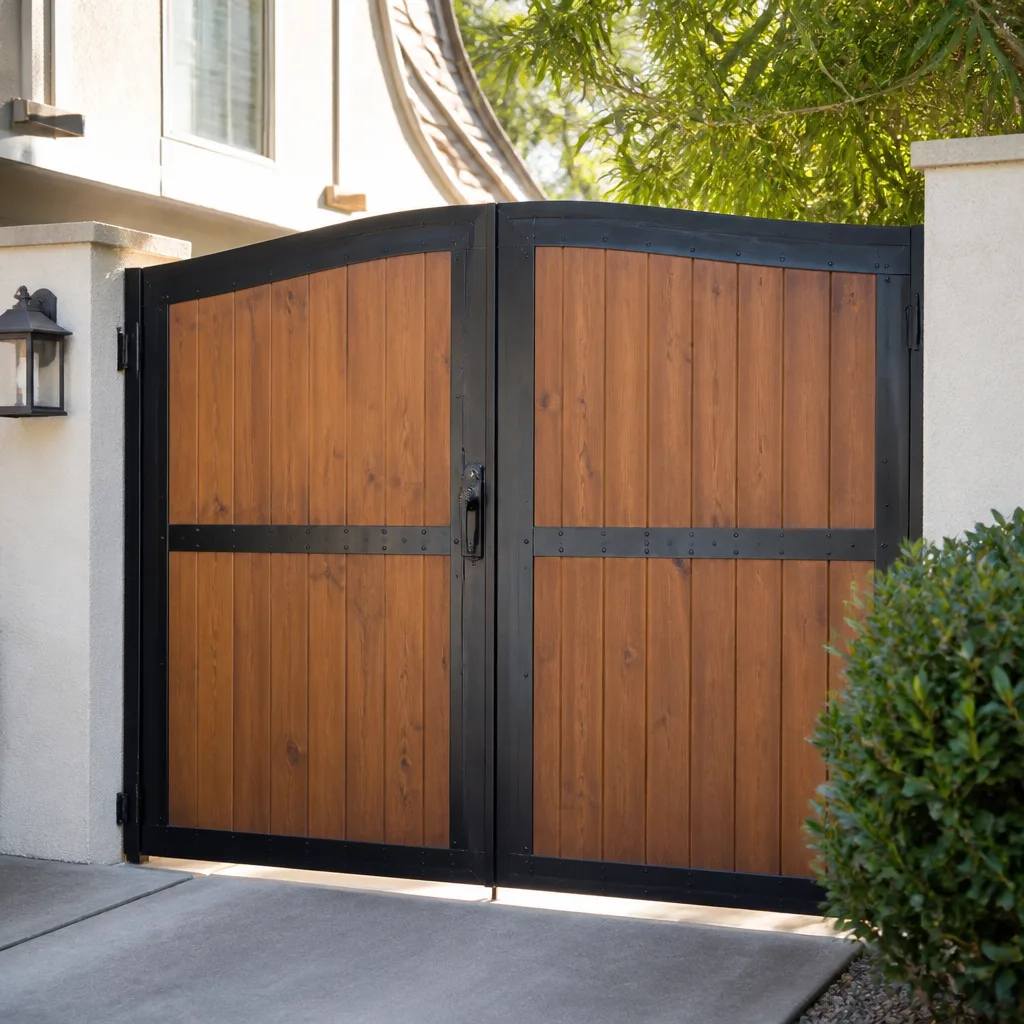 Wood & steel frame
 Farm & ranch
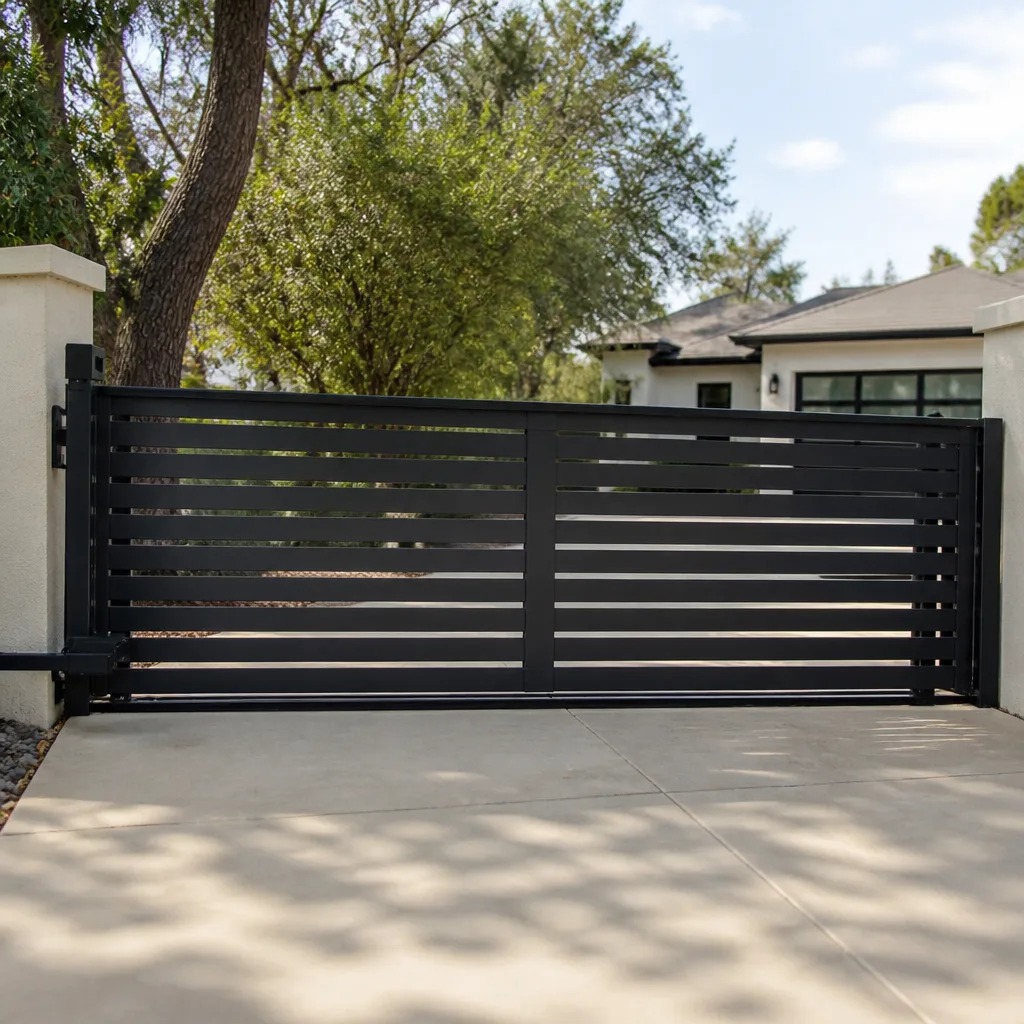 Sliding driveway gates
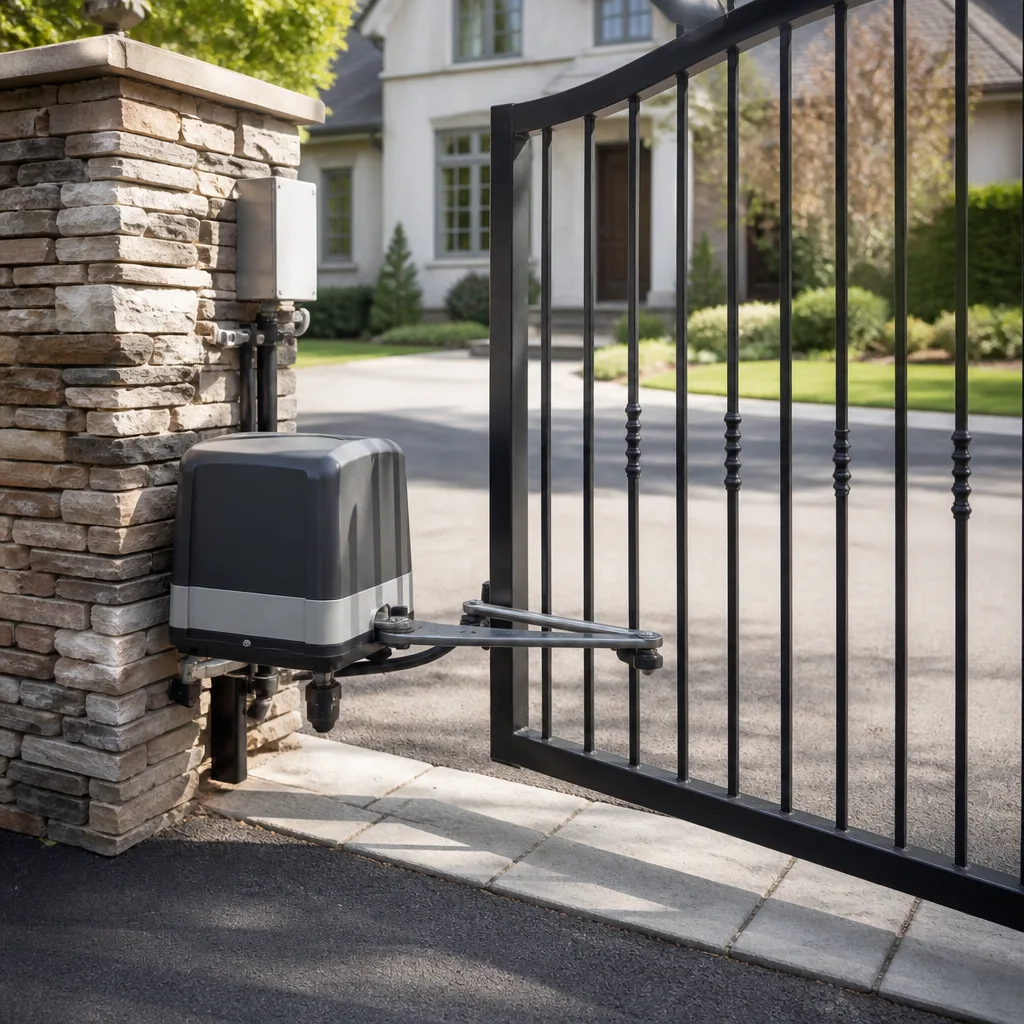 LiftMaster operators
Free on-site gate assessment - hinges, posts, and your LiftMaster or Nice gate operator checked before anything is quoted
The assessment is free and the quote is the invoice.
Get your free estimateGate Repair Maintenance Checklist for San Jose Homeowners
Lubricating a rack-and-pinion drive with the wrong grease is worse than not lubricating it at all. Many spray lubricants contain solvents that slowly degrade the nylon rack teeth until the pinion starts skipping. That grinding sound you hear is the gear eating itself. Most “universal” gate maintenance checklists cause this exact problem because they ignore a basic fact: a sliding gate, a swing gate, and a vertical pivot gate share almost no mechanical components. This guide breaks maintenance down by operator type so you can stop guessing and start doing the maintenance that actually preserves a gate in San Jose’s dry heat and occasional downpours.
Quick Answer
The correct gate maintenance checklist for San Jose depends entirely on what type of gate you have. Slide gates need monthly rack-and-pinion cleaning and a chain tension check; swing gates need hinge lubrication and arm alignment every three months; all three types need photo-eye cleaning, obstruction-sensor testing, and control-board inspection on a regular schedule. The full breakdown below tells you exactly what to do, what to skip, and what to call gate repair for before a minor issue becomes a failure.
Styles & brands we work with
- Wrought iron
- Wood & steel frame
- Farm & ranch
- Sliding driveway gates
- LiftMaster operators
Table of Contents
- Identify Your Gate Type First
- Slide Gate Maintenance Checklist
- Swing Gate Maintenance Checklist
- Vertical Pivot Gate Maintenance Checklist
- Electrical and Control Board Checks
- Battery Backup Health Checks
- San Jose Weather-Specific Care
- How to Test Auto-Reverse Correctly
Identify Your Gate Type First
Before touching any tool, you need to know what you’re maintaining. The three most common automated gate types in San Jose neighborhoods from Silver Creek to Evergreen to Almaden Valley are mechanically distinct, and applying the wrong checklist is how we see good gates get damaged.
Slide gates roll horizontally on a track and are usually driven by a chain or rack-and-pinion. You’ll see a long metal rack bolted along the bottom of the gate panel, with a toothed pinion gear on the operator. These are the most common in this area because they don’t need swing clearance.
Swing gates pivot on hinges like doors, usually in pairs. The operator is either an arm that pushes and pulls the panel or an underground actuator. Swing gates put more stress on hinge points and arm connections than slide gates put on their track.
Vertical pivot gates lift upward on a pivot arm, common on commercial and some hillside residential properties in San Jose where the driveway slope makes a sliding or swinging panel impractical.
Once you know the type, keep this guide handy and work the correct section. If you’re not sure what you have, a quick photo sent to a specialist will get you sorted.
Slide Gate Maintenance Checklist
Slide gates are the workhorses of San Jose residential properties, and they fail in predictable ways. Most slide-gate failures we diagnose come from two things: dry or contaminated chain assemblies, and rack teeth clogged with caked dust. Neither is difficult to correct if you stay ahead of it.
Monthly
- Clean the rack and pinion. Use a dry brush or compressed air to remove dust and grit from the rack teeth and the pinion gear. San Jose’s dry season from roughly April through October puts a film of fine dust on everything, and that dust turns into abrasive paste when mixed with grease.
- Check chain tension. On chain-driven operators, press down on the chain at its midpoint. It should have roughly 1/4 to 1/2 inch of deflection. A loose chain slaps and jumps teeth; an over-tight chain wears bearings and sprockets early.
- Look at the track and rollers. Remove leaves, pebbles, and debris from the track path. A pebble in the track is enough to trip the obstruction sensor and stop the gate mid-cycle.
Quarterly
- Lubricate the chain with a dry chain lube. Chain lube formulated for roller chains is fine. Never use WD-40 or penetrating oil on a chain; it thins the existing grease and flings off. Wipe the chain down, then apply a thin, even coat.
- Lubricate the rack with a silicone-based lubricant only if the rack is nylon. Nylon racks usually need no lubrication. If you must apply something, use a silicone spray that contains no petroleum solvent. Petroleum solvents attack nylon and cause it to become brittle and chip.
- Check the end stops. Slide gates have physical stops at both ends of travel. Make sure they’re solid and not cracking. A broken end stop lets the gate overtravel and bind against the opener.
Swing Gate Maintenance Checklist
Swing gates look simpler than slide gates, but the hinge geometry means a small misalignment becomes a big load on the operator. The arm has to push a heavy panel through a long arc, and any resistance shows up as a burnt-out motor or a bent arm.
Monthly
- Walk the gate through a full cycle and listen. Creaking, popping, or grinding at the hinge says metal is moving where it shouldn’t. Catch it now, before it becomes a broken weld.
- Check the arm attachment bolts. The operator arm bolts to the gate and to the post. Vibration works those bolts loose. Check both ends with a wrench.
- Clear the swing path. Potted plants grow, pavers shift, landscape edging creeps. A swing gate needs the full arc clear. Anything touching the gate mid-swing adds load to the motor.
Quarterly
- Grease the hinge pins. Use a lithium-based grease in a grease gun on hinge points that have a zerk fitting. If your hinges don’t have fittings, apply grease directly to the pin and work the gate back and forth a few inches to distribute it.
- Check the gate’s level and sag. A sagging swing gate binds at the latch post and then drags on the ground. With the gate closed, look at the gap top and bottom along the latch edge. Uneven gap means the panel is sagging and needs a hinge adjustment from an electric gate repair technician.
- Tighten the post mounts. Gate posts can loosen over time, especially if the post sits in soil rather than concrete. Grasp the post and try to rock it. Movement means the foundation is failing and needs attention before the gate tears the operator off the post.
Vertical Pivot Gate Maintenance Checklist
Vertical pivot gates put the entire weight of the panel on the pivot assembly, and that assembly is often a single point of failure. The good news is that maintenance is minimal. The bad news is that failure is usually sudden and total.
Monthly
- Watch the gate open and close fully twice. Vertical pivot gates should lift smoothly without jerking or pausing. Any hesitation means the pivot or the operator is binding.
- Lubricate the pivot bearing. One or two drops of a heavy-weight machine oil on the pivot point each month is enough. Do not over-oil; excess oil collects dust and turns to sludge.
- Check the counterweight or spring balance. If your gate uses a counterweight or balance spring, confirm the gate doesn’t feel unusually heavy when you disengage the operator and move it by hand. Heaviness is the first sign the balance system is failing.
Quarterly
- Inspect the pivot arm for cracks. The arm takes repeated cyclic load every time the gate opens. Look for hairline cracks at the weld points and around the pivot pin. A cracked pivot arm is not a repair; it’s a replacement.
- Check the hydraulic or mechanical operator fluid. If your vertical pivot gate runs on a hydraulic operator, check the reservoir level and look for leaks at the fittings. Hydraulic systems don’t burn fluid, so a low reservoir means a leak somewhere.
Electrical and Control Board Checks
The mechanical side of a gate is easy to see. The electrical side hides in a box, and it’s where water, dust, and insects do their worst work. In San Jose, control board failures spike right after the first heavy rain of the season because moisture gets into housings that have been baking in dry air for eight months and then suddenly swell with condensation.
Monthly
- Open the control box and look. No tools needed. Look for spider webs, ant trails, wasp nests, and dust bunnies. Insects love the warmth of control boards and their carcasses can short a circuit.
- Check for moisture or corrosion. Look at the board terminals for white or green fuzz, and look at the bottom of the enclosure for standing water. If you see any, dry it out and identify where water is getting in.
- Verify the status lights. Most operators from Mighty Mule, LiftMaster, FAAC, and BFT have diagnostic LEDs on the board. Red or blinking lights mean a stored fault code. Take a picture of the code before resetting anything.
Quarterly
- Clean the photo-eye lenses. These are the small round sensors on either side of the gate opening. San Jose dust coats them until the beam can’t pass, and the gate refuses to close. Clean both lenses with a dry microfiber cloth, not a wet one.
- Check wire connections. With the power disconnected at the breaker, gently tug on each wire connection in the control box. A loose terminal causes intermittent faults that are hard to track down.
- Verify the safety loop or edge sensor. If your gate has a ground loop or a pressure edge on the leading edge of the panel, test it by placing a non-metallic object in the gate’s path while it closes. The gate should stop and reverse immediately.
Battery Backup Health Checks
Power outages in the South Bay have made battery backup systems more common on residential gates, especially in areas like Blossom Valley and the east foothills. A battery backup is only useful if it works when the grid drops, and batteries fail silently.
Monthly
- Check the battery indicator. Most operators with battery backup have a green or amber LED on the battery unit or the control board. Green means the battery is charged and holding. Amber or red means degradation.
- Run a brief backup test. Disconnect the operator from AC power at the breaker or use the battery test switch if equipped. Open and close the gate once on battery power. It should operate at normal speed, not slowly.
Six-Month
- Check battery voltage with a multimeter. A 12V battery should read between 12.5 and 13 volts at rest. Anything under 12.2V means the battery is losing capacity and will likely fail during an extended outage.
- Inspect for swelling or corrosion. Look at the battery case for bulging sides and at the terminals for white corrosion. Either means the battery needs replacement regardless of voltage reading.
If your gate’s backup system isn’t keeping up, a technician who works across operator brands including Linear, Viking, Ghost Controls, DoorKing, and Elite can tell you whether the problem is the battery, the charging circuit, or the control board.
San Jose Weather-Specific Care
San Jose has two weather modes, and each one damages gates in a different way. The long dry season from late spring through fall produces continuous fine dust. The short wet season brings quick, heavy rains that expose every gap in a control box seal.
Dry Season (Roughly April-October)
- Increase photo-eye cleaning frequency. What’s fine monthly in January might need weekly cleaning in August. Dust storms and construction activity along the 101 and 85 corridors put particulate in the air constantly.
- Watch for dry-chain wear. A chain that runs dry through the summer wears sprockets and develops tight spots. Listen for a clicking or ticking that follows the chain speed. That’s a dry link.
- Keep the control box closed. It’s tempting to leave the box open on hot days, but an open box is an invitation to dust and insects. Keep the enclosure sealed.
Wet Season (Roughly November-March)
- Check the control box gasket. The rubber gasket around the enclosure door compresses over time. If it’s cracked, flat, or missing chunks, water gets in during a downpour. Replace the gasket before the rain starts.
- Verify drainage around the post. Standing water at the base of a gate post softens the surrounding soil and accelerates post lean. Make sure water drains away from the post foundation.
- Check for water in the underground actuator vault. If your swing gate runs on an underground actuator, open the vault lid after any big storm and look for standing water. Underground actuators have seals, but seals age.
How to Test Auto-Reverse Correctly
Every automated gate sold or installed in California must have a functioning obstruction-detection and auto-reverse system. The test is simple, but most homeowners do it wrong, and a wrong test gives false confidence.
The wrong way: standing next to the gate and putting your hand in the path. Your hand gives way, the gate brushes past, and you think everything works.
The right way: place a rigid object in the gate’s path that the gate cannot easily push aside. An empty five-gallon bucket or a small wooden crate works. Start the gate closing, let it hit the object, and watch the response. The gate must stop and reverse within two seconds of contact. It must reverse with enough force to actually move away from the object, not just stop and sit against it.
- Clear the area and make sure no pets or children are nearby.
- Place a rigid test object securely in the gate’s closing path.
- Trigger the close cycle normally, not with manual override.
- Watch to confirm the gate stops and reverses within two seconds.
- Repeat the test from the other direction if your gate is a slide gate that opens in one direction only.
- If the gate fails the test, stop using the automatic function and call a professional immediately.
A failed auto-reverse test is not a convenience issue. A gate that doesn’t reverse is a liability. If a child, a pet, or a delivery person is caught between the panel and the post, the result can be fatal. This is the one maintenance step that you never postpone.
Common Mistakes to Avoid
- Using WD-40 or any penetrating spray on a chain or rack. Penetrating oils thin the existing lubrication and leave the metal dry. On nylon racks, the petroleum solvent degrades the plastic over time. Use a dry chain lube for chains and a silicone-only product if the rack needs anything at all.
- Lubricating a rack-and-pinion that doesn’t need it. Most nylon racks are self-lubricating. Adding grease makes them collect San Jose dust until the rack teeth are packed with grit. That grit grinds the pinion.
- Cleaning photo-eyes with a wet cloth. Water streaks across the lens and the beam scatters. A dry microfiber cloth removes dust without leaving residue.
- Ignoring a gate that’s getting slower. A gate that moves slower than it did six months ago is telling you something is wearing out. Ignore it, and you’ll be calling for emergency gate repair instead of scheduled maintenance.
- Thinking your battery backup is fine because it beeped once. A battery that beeps and then runs normally on AC power still has degraded cells. The only reliable test is a periodic disconnect from AC and a voltage check.
- Spraying lubricant into the control box. Nothing inside the control box needs lubricant, and the conductive residue can short a board. Keep all spray products away from the electrical enclosure.
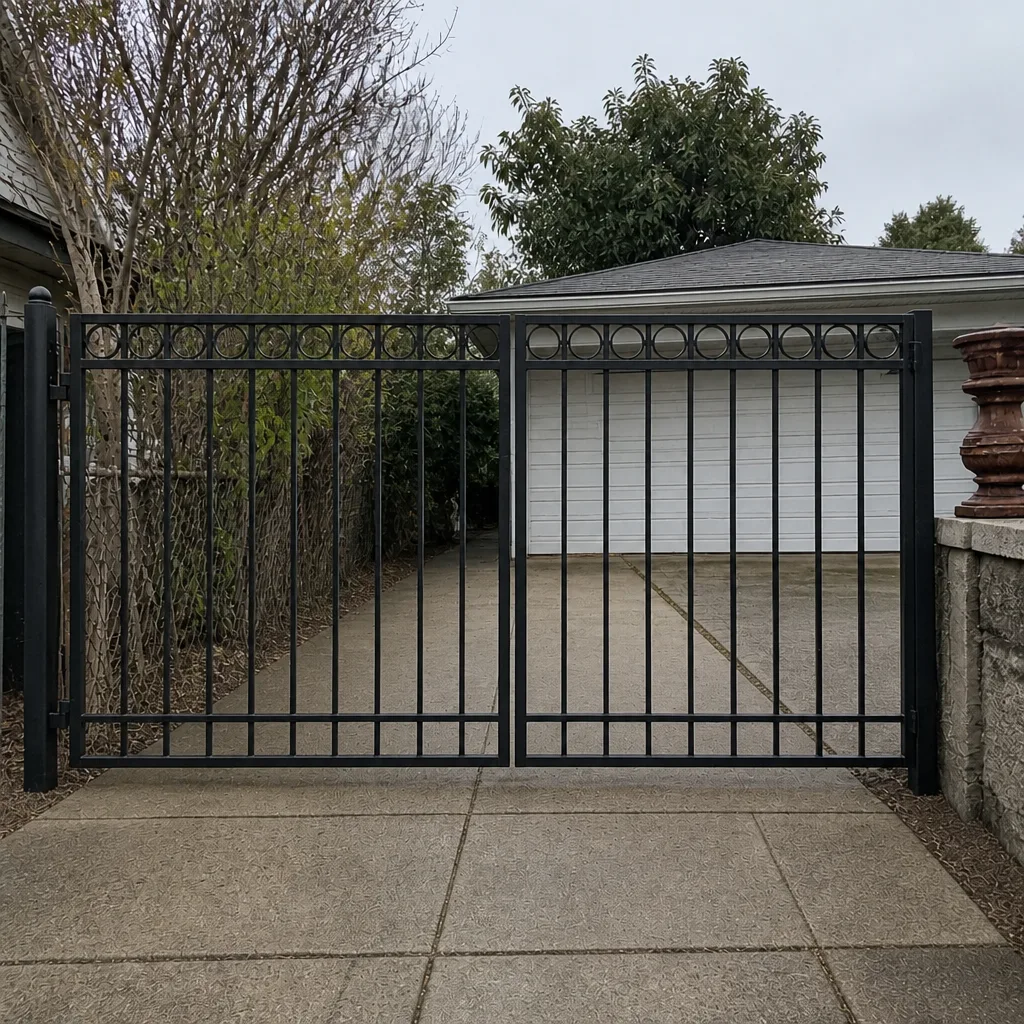
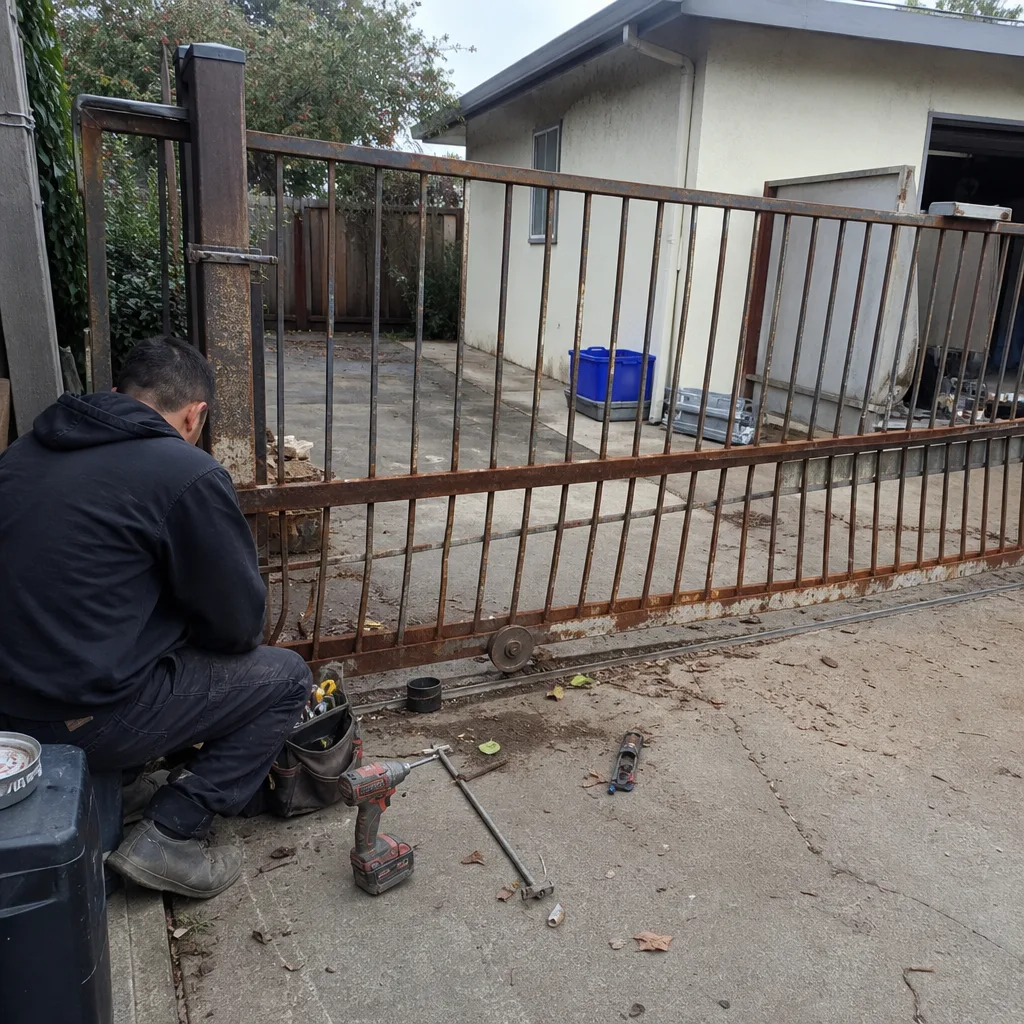
See the difference
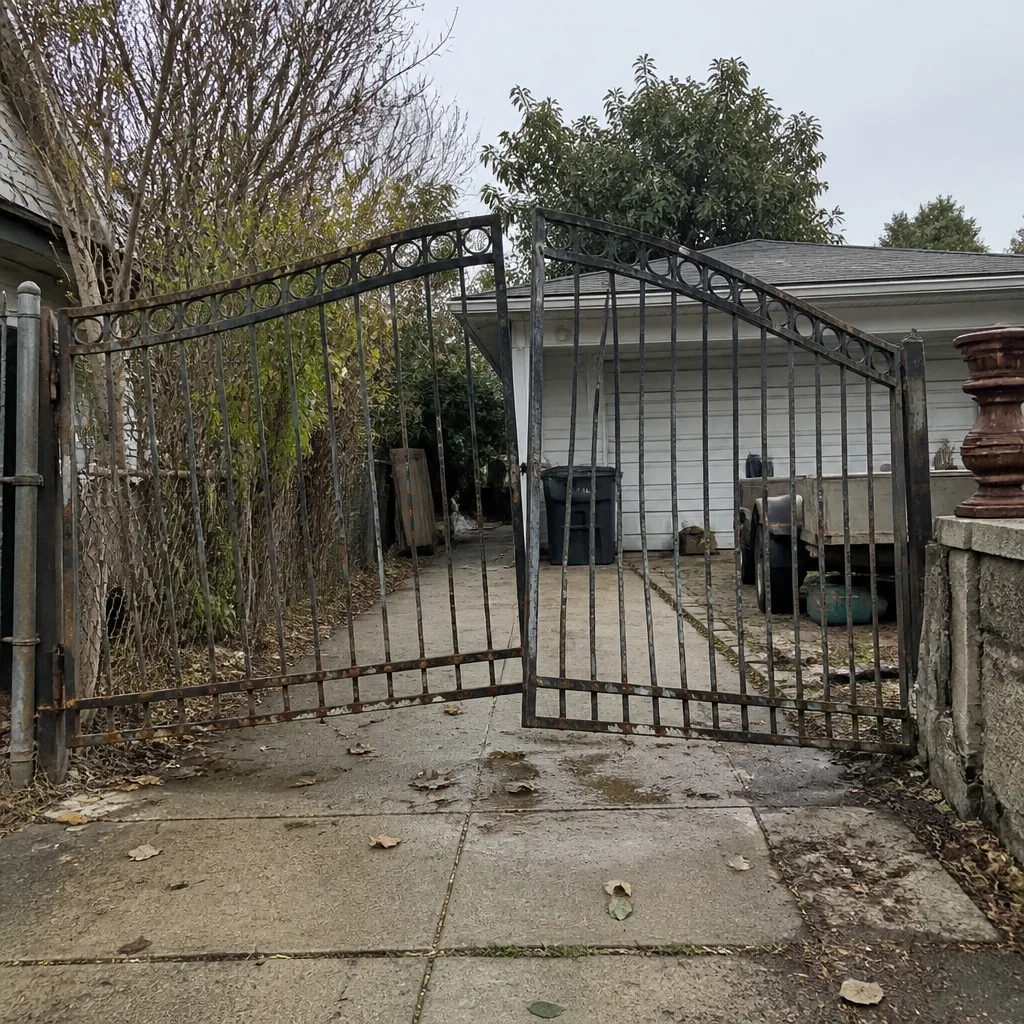 Before
 After
 Before
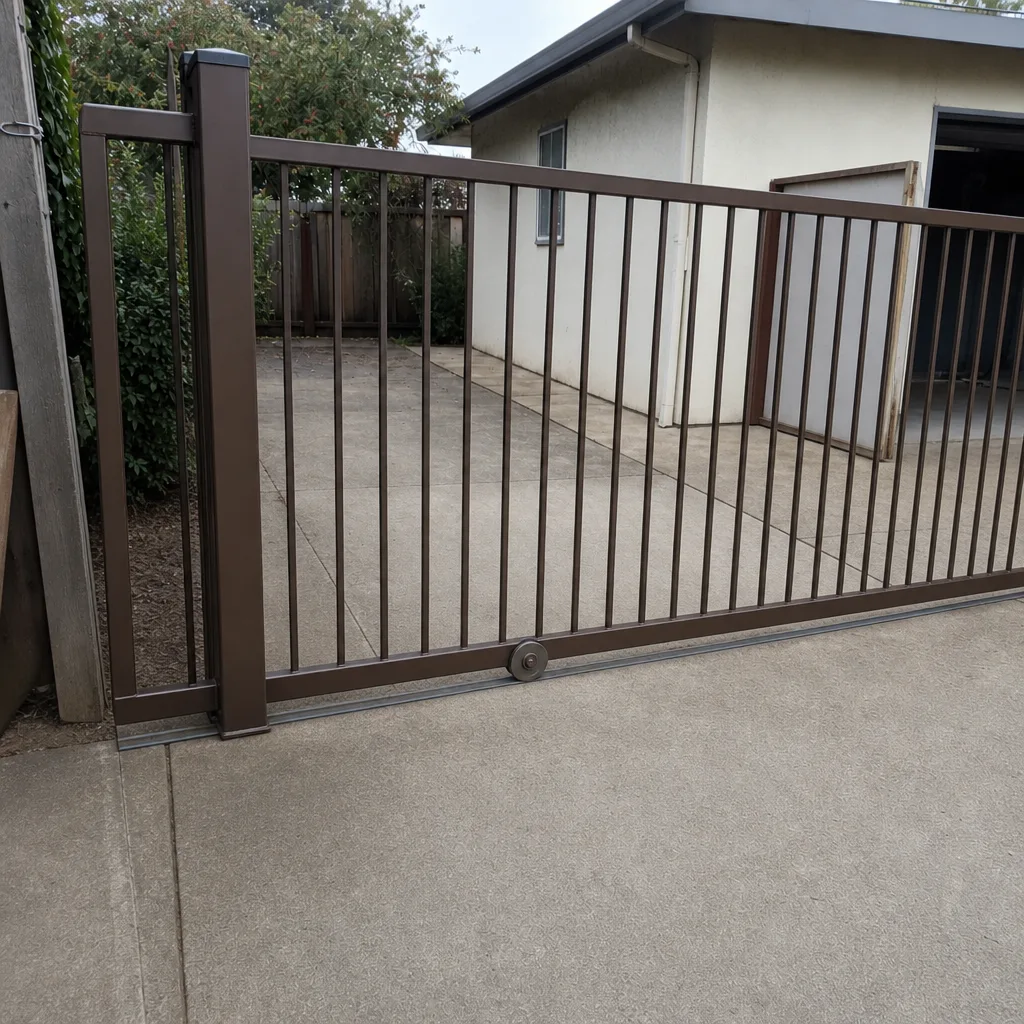 After
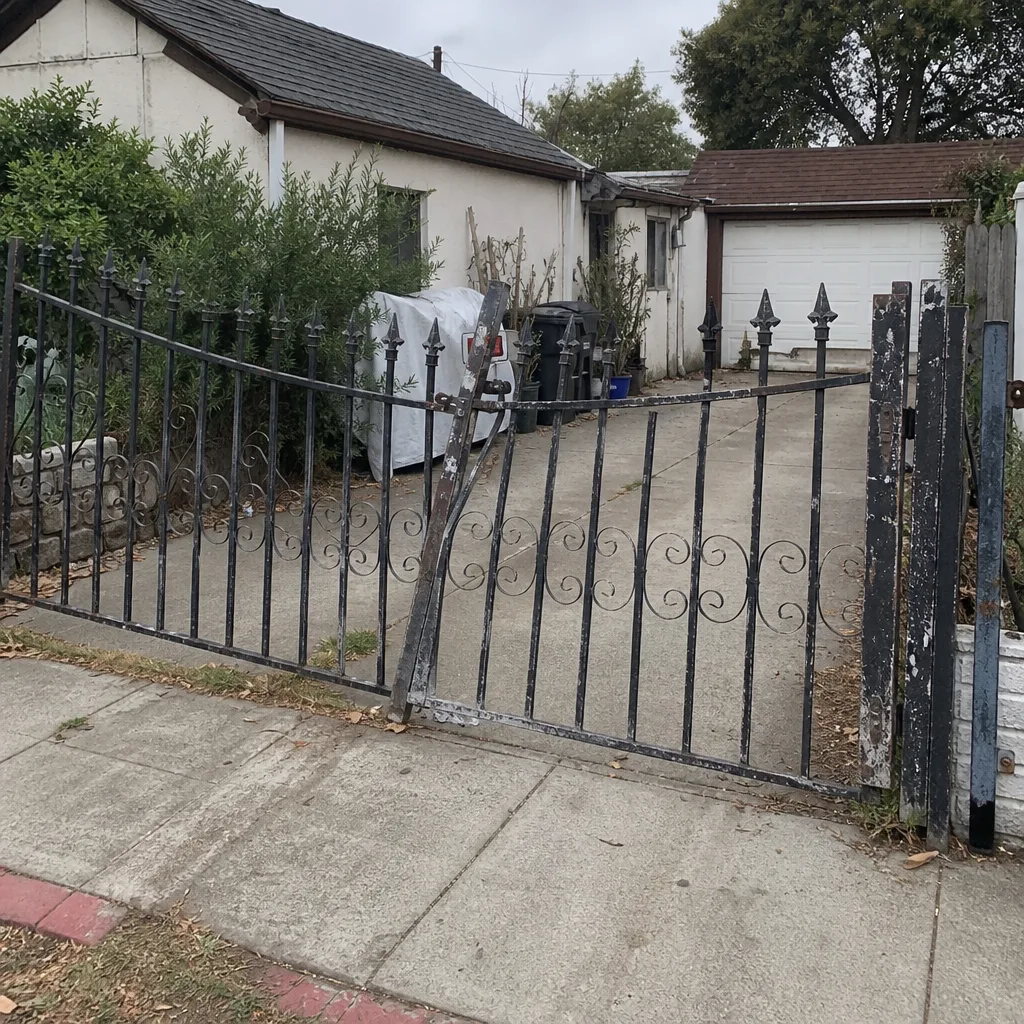 Before
 After
When to Call a Professional
Some maintenance finds problems you shouldn’t fix yourself. If the gate fails the auto-reverse test under any condition, stop using the automatic function and call a technician immediately. A cracked pivot arm, a sagging gate that’s pulling away from its hinge, a burnt smell from the control box, or repeated circuit breaker trips are all stop-and-call conditions. Gate operators contain capacitors that hold voltage even when unplugged, so control-board work is not a DIY job.
Gate Repair Blossom Valley offers free estimates in San Jose. Our technicians work across nine operator brands including LiftMaster, FAAC, BFT, Linear, Viking, Ghost Controls, DoorKing, Elite, and Mighty Mule, so the diagnostic is specific to your equipment, not a generic guess. Call (877) 358-4473 and we’ll tell you what’s wrong and what it costs before any work is done.
Frequently Asked Questions
Monthly for basic checks like track cleaning and chain inspection, and quarterly for lubrication and electrical inspection. Homes in high-dust areas of San Jose such as the east foothills and anywhere near major construction often benefit from photo-eye cleaning every two weeks during the dry season.
Photo-eye failure from dust buildup is the most common call we see in San Jose. The eye lenses get coated with fine particulate during the dry season, the gate refuses to close, and the homeowner thinks the operator has failed. A dry-cloth cleaning fixes it in most cases.
Yes, if you use the right product for the right component. Chains take dry chain lube, hinge pins take lithium grease, and nylon racks usually take nothing at all. Using the wrong spray is worse than skipping lubrication, especially on nylon rack teeth.
We don’t sell maintenance plans or subscriptions. Every visit is a one-time service priced after we look at the gate. That means no monthly fees and no contract, just a written estimate for whatever the gate actually needs. Call (877) 358-4473 for a free estimate.
We service equipment from nine brands: LiftMaster, FAAC, BFT, Linear, Viking, Ghost Controls, DoorKing, Elite, and Mighty Mule. That covers the residential operators common in San Jose neighborhoods and the commercial operators used by local HOAs and apartment complexes.
Our technicians clean and inspect the rack and pinion or chain, lubricate all required points with the correct products, test the auto-reverse system, verify photo-eye alignment, check the control board for moisture and corrosion, and test any battery backup. You get a written report and a clear recommendation for anything that needs attention, with the price upfront before any repair work is approved.
The Bottom Line
A gate that’s maintained correctly lasts years longer than one that’s neglected, and the maintenance that matters is specific to the gate type. Slide gates need clean racks and properly tensioned chains. Swing gates need well-greased hinges and solid arm connections. Vertical pivots need pivot-point attention and balance checks. All of them need clean photo-eyes, dry control boards, tested auto-reverse, and a working battery backup. Do the monthly and quarterly work, avoid the wrong lubricants, and call a professional when you find something beyond routine wear.
Written by the team at Gate Repair Blossom Valley, serving San Jose since 2015.