
Emergency Gate Repair Near Me: What San Jose Homeowners Should Do First
When your gate stops responding at midnight or refuses to close before you leave for work, the first thing to do is check the manual release on your operator. In most San Jose neighborhoods, that single step resolves the issue in under two minutes and costs nothing. If it doesn’t, shut power to the operator at the breaker, secure the gate temporarily, and call a technician who knows your brand. If you’d rather not troubleshoot it yourself, call (877) 358-4473 and we’ll walk you through it.
We’ve spent years working on automated gates across the South Bay, and the pattern is consistent: homeowners call in a panic before checking anything, then discover the fix was something they could have done with a flathead screwdriver and thirty seconds of patience. The difference between a $0 fix and an emergency service call often comes down to knowing your system’s override sequence.
This guide walks through the correct order of operations when your gate fails, organized by what actually matters: your gate type, not your stress level. We work on LiftMaster, Linear, Viking, Ghost Controls, DoorKing, and the rest of the major brands, so the steps below are written for real systems, not generic advice.
Key Takeaways
- Check the manual release before calling anyone. It resolves most emergency situations in under two minutes.
- Know whether you have a swing operator, slide operator, or barrier arm. The override procedure differs for each.
- Work through a five-step diagnostic checklist before you pick up the phone.
- Secure a stuck-open gate immediately, especially in commercial settings or homes with pools, pets, or young children.
- Have your operator brand and model ready when you call. It cuts diagnostic time significantly.
- Not every after-hours failure is an emergency. Evaluate the actual security risk before deciding whether to wait.
Step One: Know Which Manual Release Your Gate Uses
Every automated gate has a manual release mechanism that disconnects the operator from the gate leaf. It exists so you can move the gate by hand when power fails or the electronics lock up. The release design varies by operator type, and pulling the wrong component or forcing the wrong arm can damage the drive mechanism.
Swing Gate Operators
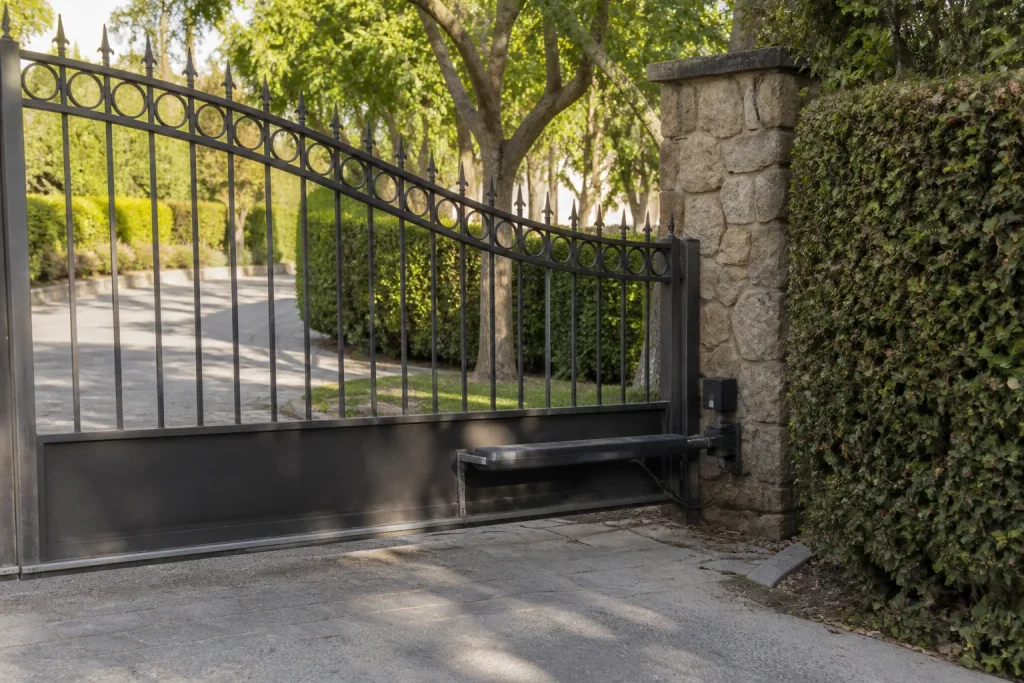
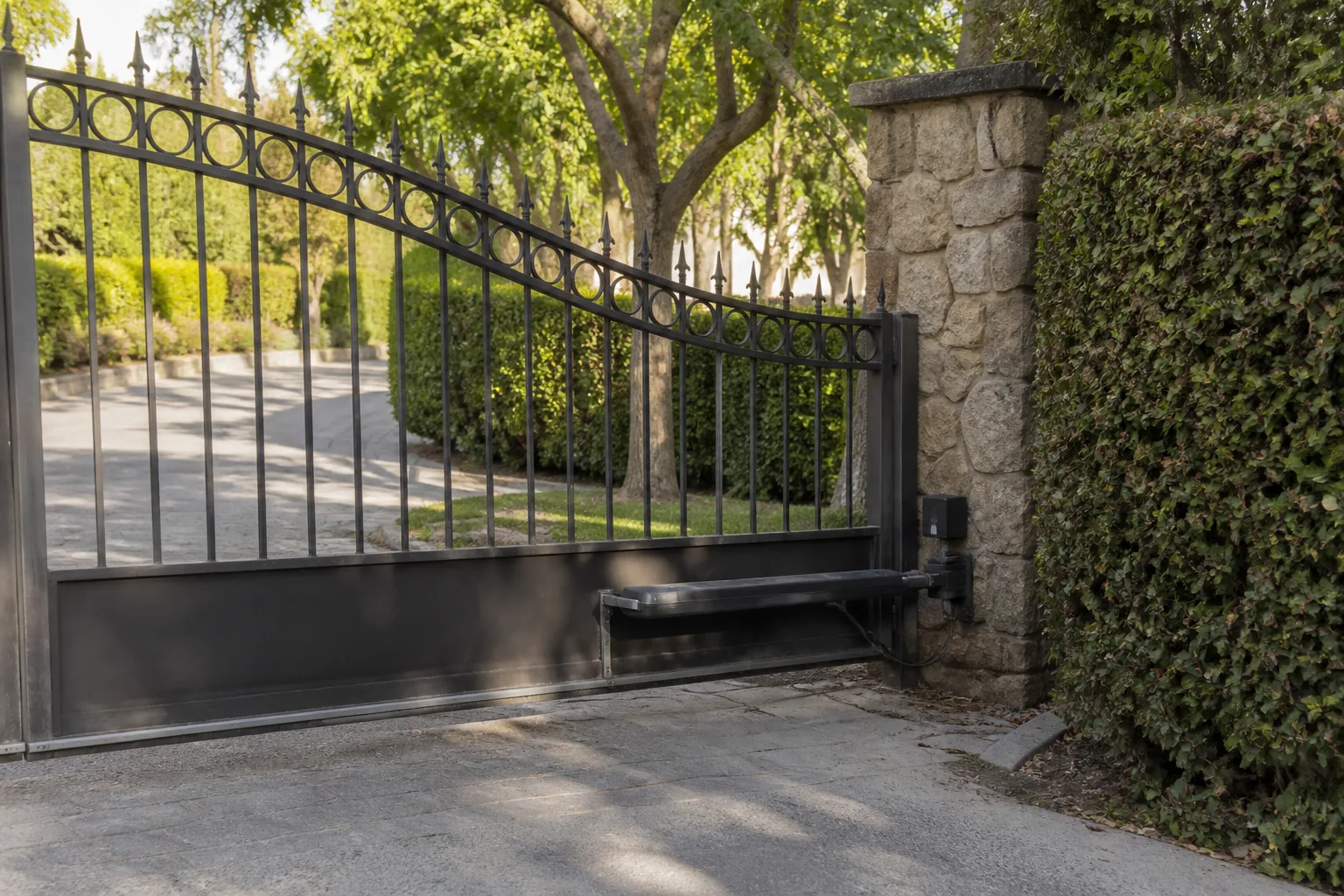
Swing gates use an articulated arm, a piston, or a buried operator. Most residential swing operators from brands like Mighty Mule and Ghost Controls use a simple pin or lever release at the point where the arm meets the gate bracket. You pull the pin, the arm disconnects, and the gate swings freely. Some models hide the release under a small cover plate. If you have a Viking or FAAC swing operator, the release is typically a red knob or lever on the operator housing itself. Turn it counterclockwise to disengage. Slide operators work differently, and confusing the two procedures is the most common way homeowners make a bad situation worse.
Slide Gate Operators
Slide gates ride on a track with a toothed rack along the bottom. The operator sits on a concrete pad beside the gate and drives a gear that engages that rack. To release a slide gate, look for a clutch or release lever on the operator housing. On DoorKing and Linear slide operators, you’ll find a small red T-handle or a keyed release. Turn or pull it, and the drive gear drops away from the rack so the gate can be pushed by hand. Do not attempt to force a slide gate that has not been released. You can bend the rack or shear the drive gear teeth, turning a simple reset into a parts replacement.
Barrier Arm Operators
Barrier arms are the simplest to release. Most have a spring-loaded mechanism at the base that lets you lift the arm vertically by hand even when the motor is locked. LiftMaster and BFT barrier arms typically allow manual lifting without any tool. If the arm will not lift, check whether a manual release pin or locking latch is engaged near the pivot. None of these procedures should require significant force. If you’re straining, stop and call us before you damage the operator.
The Five-Step Diagnostic Checklist Before You Call
Once you’ve confirmed the manual release and you know you can move the gate, run through this checklist. It takes five minutes and eliminates the most common causes of gate failure. We ask every San Jose homeowner to do this before calling, because half the time the problem is not the gate at all.
- Power at the outlet. Is the operator plugged into a GFCI outlet that has tripped? Press the reset button on the outlet. In older San Jose homes, garage and exterior outlets often share a circuit with something unexpected. Check whether anything else on the same circuit is dead.
- Breaker status. Find the breaker that feeds the gate operator. It may be labeled “gate,” “exterior,” or something vague. If it’s tripped, flip it fully off and then back on. If it trips again immediately, stop. That indicates a short or a failed component, and continuing to reset it can damage the control board.
- Battery backup indicator. Many modern operators, especially commercial-grade units from DoorKing and Viking, have battery backup systems. Look for a status LED on the operator or an alarm tone. A constant beep or a red light often indicates a low or failed battery. If the gate runs on battery but not line power, the problem is upstream of the operator.
- Obstruction scan. Walk the full length of the gate track or the swing arc. Look for anything that could trip the safety sensors or physically block movement. In San Jose, we see a lot of gates knocked out by overgrown ivy, a shifted paver, a palm frond, or a kid’s scooter left in the track. Remove the obstruction and try again.
- Safety sensor check. Most automated gates use photo eyes or edge sensors to prevent crushing. If a sensor is misaligned, dirty, or blocked, the gate will refuse to move. Check that the photo eye lenses are clean and that both units are pointed at each other. Some systems flash a diagnostic code on the control board when a sensor is at fault.
If all five steps check out and the gate still will not move, you’ve done your homework. The problem is likely in the control board, a capacitor, a limit switch, or the motor itself. That’s the point where your call to us actually saves time instead of adding to it.
How to Temporarily Secure a Gate That’s Stuck Open
A gate that will not close is more than an inconvenience. In San Jose, it’s a direct line to whatever is behind it: a backyard, a courtyard, a parking area, a pool. The security triage depends on what kind of property you have and what the gate protects.
For a residential property, the priority is preventing accidental entry and keeping kids or pets from wandering out. If you’ve released the operator and the gate is now free-swinging, secure it in the closed position if possible. A pair of heavy-duty zip ties around the gate frame and a post will hold a standard residential gate for a night. A chain and padlock is better. If the gate cannot be physically closed because of a broken hinge or a dropped leaf, use a temporary barrier across the opening: a vehicle pulled across a driveway, caution tape, or a sheet of plywood. Make sure anything you put up is visible, especially at night. You don’t want a pedestrian walking into a knee-high cable.
For commercial properties or any gate that secures expensive equipment, the calculation changes. A stuck-open gate at a storage facility or a service yard is a liability. In those situations, you need a technician dispatched quickly. We work on high-cycle commercial operators from DoorKing and Viking regularly, and those systems often have fail-secure logic that can be manually re-engaged. If you manage a commercial gate in San Jose, have a written protocol for gate failures and post it where staff can find it. The person on site at 6 a.m. should not be figuring out the manual release for the first time.
On the other side, a gate stuck closed is usually easier. If you’ve released the operator, you can open it manually. The main risk here is someone forcing the gate and damaging the rack, the hinge, or the operator arm. Post a note on the gate if other people might try to open it, and tell everyone in the household to leave it alone until the technician arrives.
What Information to Have Ready When You Call
This is where a little preparation shaves real time off the repair visit. The more we know before we arrive, the faster we can isolate the problem and the fewer trips we make. Here’s what actually helps:
- Operator brand. Look at the operator housing. This matters more than anything else. A LiftMaster failure looks different from a Ghost Controls failure, and we stock or can source parts for all of them. We’re not guessing when you tell us you have a Linear slide operator versus a Viking swing operator. We know the failure patterns for each.
- Model number if visible. There’s usually a sticker on the side or bottom of the operator housing. A photo is even better. Text it to us when you call.
- What happened immediately before the failure. Was there a power fluctuation? A storm? Did the gate start moving slower than usual last week? Did it reverse unexpectedly? Did someone hit the gate with a car? The sequence of events is often more diagnostic than the symptom itself.
- What the gate is doing now. Dead silent? Humming but not moving? Clicking? Running but stopping halfway? Opens but won’t close? Each behavior points to a different component.
- What you’ve already checked. If you worked through the five-step checklist, tell us. We won’t make you repeat it, and knowing the breaker, the outlet, and the sensors are all clear moves us past the obvious causes immediately.
Call (877) 358-4473 with that information in front of you. We answer 24/7. Fast dispatch from 7am to 7pm, Sunday through Friday. And when we say we work on your brand, we mean it: LiftMaster, FAAC, BFT, Linear, Viking, Ghost Controls, DoorKing, Elite, and Mighty Mule. Diagnosed, not guessed.
When to Call for Dispatch vs. Waiting Until Morning
Not every gate failure at 9 p.m. is an emergency. We’re honest about this because telling a San Jose homeowner to wait until morning when they genuinely can’t secure their property is worse than telling them to call. Here’s how to evaluate it.
Call now if: the gate is stuck open and it protects a pool, a young child, a pet, expensive equipment, or commercial inventory. Call now if the gate is stuck closed and you cannot leave your property for work, school, or a medical appointment. Call now if you hear grinding, see smoke, smell burning electrical, or the operator is tripping the breaker repeatedly. Those are signs of a component actively failing and the next failure could be worse.
You can usually wait if: the gate is stuck in a closed position but you can release it manually and secure it with a chain. You can wait if the gate opens but won’t close, and you can secure the opening another way. You can wait if the problem is intermittent: the gate works most of the time and the failure is occasional. Intermittent problems rarely get worse overnight, and a daytime visit from a technician who can hear the system when it’s actually misbehaving is more productive than a 10 p.m. visit when everything tests fine.
We answer 24/7. A call outside dispatch hours is booked into the next opening, Sunday through Friday, 7am to 7pm. We’ll help you decide whether the situation justifies immediate dispatch or whether the next opening is soon enough. We’re not going to pressure you into an after-hours call you don’t need.
Why Brand-Specific Experience Matters in an Emergency
Gates share a basic anatomy: an operator, a control board, sensors, a drive mechanism, a gate leaf. But the way a Ghost Controls residential swing operator fails is not the way a DoorKing commercial slide operator fails. The diagnostics differ, the parts differ, and the manual release procedures differ.
Our technicians work across all nine major operator brands, which means they arrive already fluent in your system’s typical failure patterns. A company that mostly installs one brand may see your Linear operator and start from zero. We see a Linear operator and immediately check the known weak points. That’s the difference between a 45-minute repair and a two-hour guessing session.
We’re also an electric gate specialist, not a general contractor who happens to work on gates. That distinction matters most during emergencies, when a control board, a capacitor, a limit switch, or a safety loop is the culprit. The mechanical parts of a gate rarely fail suddenly. The electrical and electronic parts do. If your technician is comfortable only with hinges and wheels, they’re not going to solve a control board failure at 8 a.m. before your tenants start arriving.
If you’re in San Jose and your gate has failed, start with the manual release. Work through the checklist. Gather your brand and model information. Then call us at (877) 358-4473. We’ll tell you honestly whether it’s an emergency or a next-opening situation, and we’ll come with the right parts and the right knowledge for your specific system. From the opener to the hinge.
The Bottom Line
A gate emergency in San Jose is manageable if you know your gate type, your manual release, and your operator brand. Start with the override. Work the five-step checklist. Secure the opening. Gather your information. Then make one call. We work on LiftMaster, FAAC, BFT, Linear, Viking, Ghost Controls, DoorKing, Elite, and Mighty Mule systems, and we’re equipped for electric gate repair from the control board to the safety sensors, as well as full gate repair and new installations. If you’re in San Jose and need help, Gate Repair Blossom Valley offers free estimates. Call (877) 358-4473. We answer 24/7. Fast dispatch from 7am to 7pm, Sunday through Friday.
Frequently Asked Questions
Locate the manual release on your operator. Swing gates from Ghost Controls and Mighty Mule typically use a pin or lever at the arm-to-bracket connection. Slide gates from Linear and DoorKing use a clutch or release lever on the operator housing. Barrier arms can usually be lifted by hand. If you can’t identify the release on your system, call (877) 358-4473 and describe your operator. We’ll walk you through it.
The price depends on the failure, the parts required, and the time of day, so we give a written estimate before any work starts. The estimate is free. We don’t charge a service call fee or a diagnostic fee, and the price is agreed upon before we begin. Call (877) 358-4473 for a free estimate on your specific situation.
Yes. Same-day service is available for most failures when you call before midday, and we answer 24/7 to book your call. Fast dispatch from 7am to 7pm, Sunday through Friday. If the gate protects a pool, a child, or commercial property, tell us when you call and we’ll prioritize the dispatch accordingly.
We handle both. Electric gate repair is one of our core services, covering control boards, wiring, safety sensors, and automation components. A lot of gate companies stop at the hinges and the wheels. We diagnose and repair the full system, from the opener to the hinge.
Related services in San Jose: Blossom Valley homeowners and property managers across the city rely on us for electrical diagnostics, control board replacement, safety loop repair, and full gate replacement when a repair reveals a system that has reached the end of its useful life.
Written by the team at Gate Repair Blossom Valley, serving San Jose since 2015.
Need Gate Repair Help?
Call Gate Repair Blossom Valley - licensed & insured, here with fast help in Blossom Valley.
(877) 358-4473